|
1.
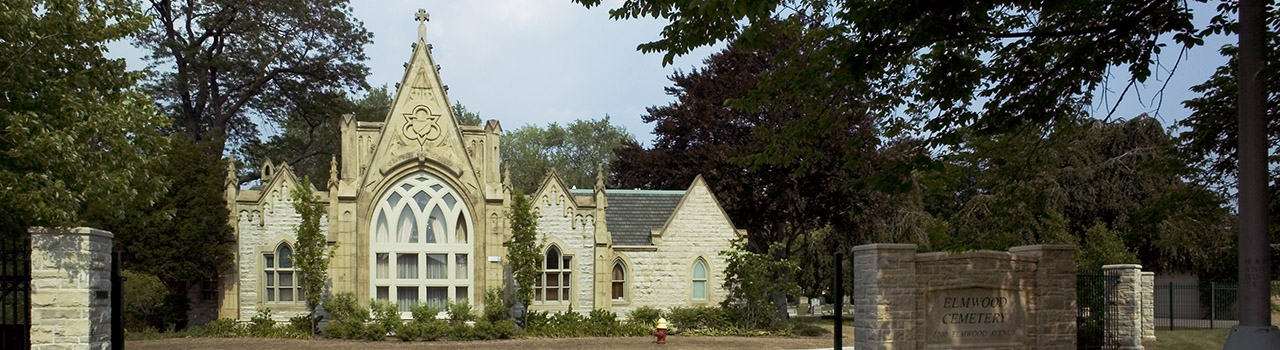
Chapel –
The old-world style chapel located on our grounds is made
of quarried limestone and designed in the Norman Gothic
style. Originally built in 1856 it was restored in 1961.
On November 17, 1976 it was destroyed in a fire. The building
was reconstructed, using public donations, to its original
grace and form. Today it is used extensively for committal
services and as a place for reflection by many of our
park’s visitors. It was renovated in 2007. |
|
 |
2.
Veiled Lady – Designed
and sculpted by Randolph Rogers, this graceful and lovely
monument on the Waterman lot, has a long and interesting
history. Carved of Carrera marble in Italy, it was shipwrecked
off the Spanish Coast on its journey to Detroit in 1869.
It was salvaged two years later, only to sink in the Hudson
River and be recovered. The monument was later toppled over
by a windstorm in 1919. |
|
 |
3.
Flying Geese – Designed by Marshall
Fredericks, this graceful statue sits on the Macauley
lot at the rear of the chapel and faces the pond. (This monument is currently being repaired.) |
|
 |
4.
Marble Urn – Located in the Hazel
Dell section, this beautiful urn once graced the grounds
of Grieg Hall, the home of the Norwegian composer Edvard
Grieg. |
|
 |
5.
Parents Creek (a.k.a. "Bloody Run")– In the center
of the green hills and valley of the park lies what was
originally Parents Creek, named after the original property
owners. On this site on July 31, 1763
during the French and Indian War, Chief Pontiac’s
Indians defeated the British regulars under the command
of Captain Dalzell and the creek was renamed Bloody Run.
Elmwood has preserved this historic section as part of
the beauty and history of the cemetery. |
|
 |
6.
Civil War Memorial Lot – Purchased
by the State of Michigan in 1874 this lot was used exclusively
as “a place of interment for deceased Michigan soldiers
and sailors of the War of the Rebellion.” Approximately
84 remains of soldiers who were previously buried in the
old soldier’s section were transferred to the new
location which now contains the remains of 205 officers
and men who fought in the Civil War. This area is one
of the few in the United States where the flag is flown
both night and day as a memorial to those patriots. |
|
 |
7.
Gatehouse – Originally built
in 1870 of quarried limestone in a late Victorian Gothic
style, it was added to in the early 1890s and extensively
restored in 1988 and 1989. The center window, shown left, was originally an open drive used to access the cemetery grounds. CLICK
HERE for Gatehouse section information. |
|
 |
8.
Mausoleum Plaza Complex – Completed
in 1994, the mausoleum complex is situated on a serene
site beside the calmly flowing brook. Individuals may
choose from crypts in one of four sheltered galleries,
cremation niches, or turf-top crypts located within the
Plaza. |
|
 |
9.
Joy Family – The Joy Family circular
burial mound has a center colonnade style monument. James
F. Joy, an attorney and the Detroit founder of the family,
is buried with his descendents around him. Two of his
sons, Richard P. and Henry B. were involved in the formation
of Packard Motor Car Co. Henry was president of the company
until World War I. Mrs. Helen Newbury Joy (wife of Henry)
was a major Detroit philanthropist. She was one of the
founders of United Foundation. |
|
 |
10.
Cass Family – Lewis Cass, Michigan’s
most powerful political figure from the 19th century, is
buried east of this impressive casket shaped monument.
Cass was Territorial Governor, U.S. Secretary of War,
Minister to France, U.S. Senator, Presidential candidate
and Secretary of State under President Buchanan. Six generations
of his descendents are buried on this lot. |
|
 |
11.
Steinberg Mausoleum – Martha Jean
“The Queen” Steinberg is entombed in this
gray and brown contemporary mausoleum. She was a Memphis
Tennessee born radio pioneer, and was considered the first
African-American woman radio station owner. In her lifetime
she was recognized as Michigander of the Year (1996) and
as a music pioneer by the Rock and Roll Hall of Fame. |
|
 |
12.
Young Sarcophagus - This single sarcophagus
is the final resting place of Detroit’s four term
Mayor Coleman Alexander Young. Young was a veteran of
World War II, Army-Air Corp. “Tuskegee Airmen”.
He was the Executive Director of the National Negro Labor
Conference and a Michigan State Senator. He was the recipient
of the Springarin Medal, the highest NAACP award. |
|
 |
13.
Mausoleum Row -
Nestled into a hillside, on one of the bends of the
central valley, are a row of family mausoleums. Five
of the cemeteries thirty private mausoleums stand side
by side as examples of a Victorian way of life. |
|
 |
14.
Green-Pack Mausoleum – Built into
the hillside on the western side of the nearly 50 foot
high slope are several late 19th century mausoleums. All
of the structures are built using gray granite for the
exterior stone. The interiors use various colors of marble
for decoration and most have stone doors with iron trim.
Pictured here is one of the two Pack Family Mausoleums. |
|
 |
Benches - Thanks to a generous donation
from the Mary Thompson Foundation new benches have been placed in select public
areas throughout the cemetery grounds. The benches
have iron framework and wooden backs and seats,
and were designed by Robert Moses for the 1932
World’s Fair. The benches sit upon antique paving bricks in landscaped
areas. |
|
 |
Gardens - Enjoy the expanding gardens at Elmwood! Specific donations of time or funds can be designated to plant floral beds, hillside groundcover or natural grasses. Garden groups are invited to adopt small or large sections at the cemetery. Our grounds crew is here to help! |
|
 |
Landscaping - In 1890, the Trustees of Elmwood engaged renowned
landscape architect Frederick Law Olmstead to
promote a unified design for the grounds of Elmwood.
The cemetery was planned as a “rural”
style burial ground. Olmstead understood this
to mean “that its scenery is to be predominating
natural rather than artificial.” He continued,
“Elmwood was probably chosen for a site
for a cemetery because of the beauty of its natural
scenery… places that we call peaceful, and
that invite rest and contemplation.” Visitors
to Elmwood can experience this design as they
move about the grounds of the cemetery, with each
turn of a lane presenting a different vista. Within
Elmwood one can easily feel that the “city”
is far away. |
|
|